This page provides additional rational and intellectual arguments supporting the existence of God. The evidence presented is drawn from physics, cosmology, analytic philosophy, and environmental science, as well as metaphysical inquiries into causality, being, and time.
Fine-Tuning of the Universe (Physics)
In the vast, silent, and largely barren expanse of the known universe, Earth stands out as a vibrant oasis teeming with life. While the cosmos is characterized by extreme heat, frozen voids, and cosmic radiation, our home planet boasts extraordinary, interconnected, finely tuned systems that foster, nurture and sustain life – most of which, although extraordinary, is easily taken for granted.
The laws of physics depend upon a set of fundamental constants whose values fall within extraordinarily narrow life-permitting ranges. Even slight variations in gravity, the cosmological constant, or electromagnetic force would render life impossible [1].
Physicist Paul Davies remarks, “The impression of design is overwhelming [2].” Roger Penrose, the English mathematician, mathematical physicist, and philosopher of science, calculated that the odds of the universe’s initial conditions occurring by chance are on the order of 1 in 10¹⁰¹²³, a figure that defies the limits of statistical plausibility [3].
The Existence of the Universe (Cosmology)
Modern cosmology strongly supports the conclusion that the universe had a beginning. Observations such as cosmic expansion, background radiation, and relativistic singularity theorems converge on the Big Bang model, indicating that space, time, matter, and energy came into existence at a finite point in the past [1].
If the universe began to exist, a simple but profound question arises: Why is there something rather than nothing? Philosophically, something cannot arise from absolute nothingness. As cosmologist Alexander Vilenkin states, “All the evidence we have says that the universe had a beginning [2].”
Therefore, the cause of the universe must transcend the universe itself. Such a cause would be timeless, spaceless, immaterial, immensely powerful, and capable of “intentional agency” (a self-aware entity acting intentionally). In other words, if the cause is timeless and changeless, it would stay that way forever unless it chose to initiate something new. Therefore, the transition from nothing to something requires an “agent” who decides to act.
William Lane Craig argues that these attributes closely align with the classical theistic understanding of God [3]. Nobel Prize–winning physicist Arno Penzias likewise observed that modern astronomy points toward a creation event consistent with the biblical doctrine of creation “ex nihilo” (out of nothing) [4].
Consciousness and the Mind

Human consciousness presents a significant challenge to a purely materialistic view of reality. Although neuroscience can identify the brain activity (electrical impulses and chemical reactions between neurons) associated with thoughts, emotions, and perceptions, it cannot explain why these physical processes give rise to subjective experience, rational thought, or self-awareness [1].
From a Christian perspective, many theologians would say these conscious experiences — including feelings, reasoning, and self-awareness — are expressions of the immaterial aspect of human nature, often identified as the soul. While the brain is the physical organ through which these experiences are expressed, the soul is understood to be the immaterial self that thinks, feels, chooses, and relates to God. This theological understanding goes beyond what science alone can establish.
Philosopher Thomas Nagel, though not a theist, admits that “consciousness is the most conspicuous obstacle to a comprehensive naturalism (a philosophy maintaining that the natural world, investigated by science, is all that exists)[2].” If the human mind is nothing more than the product of physical processes, it is difficult to explain why we should trust our reasoning to lead us to truth rather than viewing it as merely the result of chemical and electrical activity in the brain.
Moral Law in the Natural World

Across history and cultures, humans have exhibited a remarkable convergence in recognizing certain moral truths — such as the wrongness of cruelty, the value of fairness, and the goodness of justice. While moral practices differ across cultures, the underlying conviction is that some actions are objectively right and some are wrong; furthermore, these convictions seem deeply rooted in human nature.
From a Christian philosophical perspective, C. S. Lewis, the renowned British author, Oxford scholar, and influential Christian apologist, argued that this universal moral awareness points to the existence of a transcendent moral lawgiver.
In Mere Christianity, Lewis introduces the idea of the “Moral Law” or “Law of Human Nature,” observing that people instinctively appeal to a shared standard of right and wrong when making moral judgments. He reasons that such a standard cannot be reduced to instinct, social convention, or personal preference, because we often feel bound to follow it even when it is inconvenient or costly*.
*Lewis, C. S. (1952). Mere Christianity. HarperOne. (Original work published 1941–1944)
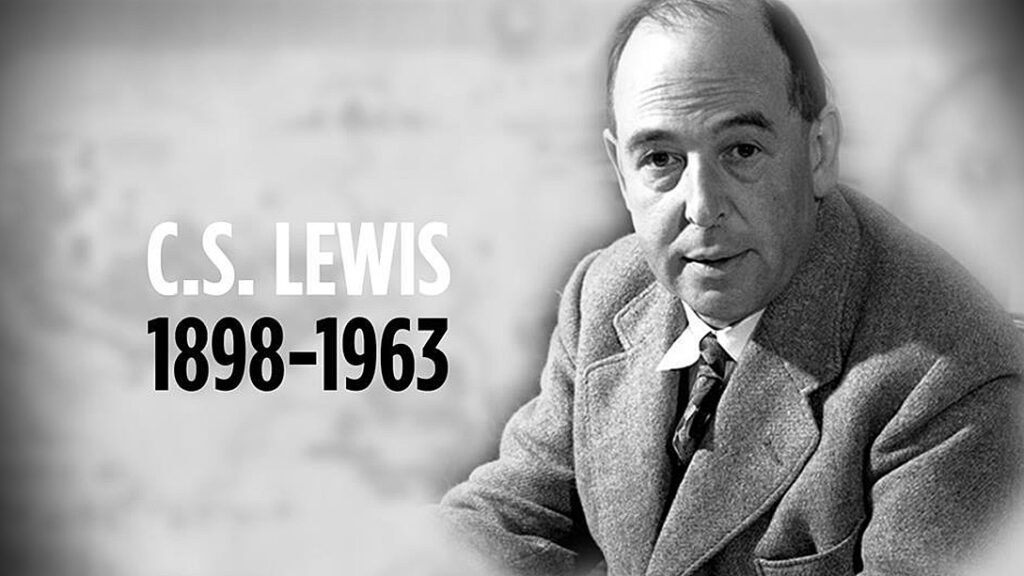
C.S. Lewis
C.S. Lewis, a staunch atheist for much of his early life, converted to Christianity in a gradual, intellectually driven process in the late 1920s and early 1930s. In his book Surprised by Joy, C. S. Lewis recounts his lifelong search for what he calls “Joy,” a deep, aching longing that first appeared in fleeting moments during his childhood and continued to elude him through years of loss, strict schooling, and a period of firm atheism.
Despite trying to satisfy this desire through achievement, reason, and intellectual life, he came to realize that Joy cannot be possessed or recreated at will and that chasing it directly only made it disappear. Gradually, through his love of myth, literature, and influential friendships, especially with authour J. R. R. Tolkien (Lord of the Rings), Lewis recognized that this persistent longing was not an end in itself but a sign pointing beyond the material world.
His eventual conversion to Christianity marked the turning point where he stopped pursuing Joy as a goal and instead understood it as evidence of a deeper, ultimate reality found in God; in doing so, he did not “capture” Joy, but finally understood its source, allowing him to experience it more fully and meaningfully than ever before.
Storytelling – Good and Evil

Storytelling throughout time consistently returns to the enduring struggle between good and evil. Themes of self-sacrifice, redemption, justice, and the triumph of light over darkness appear across genres and generations, suggesting they are deeply embedded within the human experience.
Stories function as echoes of a greater narrative fulfilled in Jesus Christ, with the human attraction to these themes revealing an innate longing for transcendent meaning, moral awareness, and the hope of redemption. Ultimately, storytelling serves as more than entertainment; it reflects the profound human condition and its inherent orientation toward the divine.
Beauty, Meaning, and Transcendence

The natural world exhibits beauty that far exceeds functional necessity. Mathematical elegance and its pervasiveness in nature, music, art, the animal kingdom, and natural landscapes evoke awe and a longing for transcendence. Swiss theologian Hans Urs von Balthasar argued that beauty is a fundamental pointer to divine glory, rather than a mere evolutionary accident [1].
Likewise, humanity’s deep hunger for meaning is difficult to reconcile with a purely accidental universe. Viktor Frankl, an Austrian neurologist, psychiatrist and philosopher, observed that the search for meaning is intrinsic to human existence and essential for psychological well-being [2].
Conclusion of Rational and Intellectual Arguments
No single argument compels belief on its own. Yet taken together, the evidence forms a powerful cumulative case: a universe with a beginning, finely tuned laws, intelligent design, rational intelligibility, information-rich life (DNA), conscious minds, objective moral values, and transcendent beauty.
Many philosophers and scientists* conclude that these features are best explained by the existence of an intelligent, personal Creator.
General Revelation

As previously stated, God has chosen to reveal Himself to humanity through two main avenues. The first is through “General Revelation” — the indirect disclosure of Himself through creation, nature, and human conscience. Much of the evidence presented in this section of the website falls under the category of general revelation, specifically through the obsevation and scientific study of the world around us.
Special Revelation

The other method that God has chosen to reveal Himself is through what theologians describe as “Special Revelation” — God’s direct, specific communication through scripture and Jesus Christ. Any exploration into the existence of God, specifically Christianity, almost certainly requires an investigation of God’s special revelation. For this, the reader is encouraged to visit the webpage – God’s Nature.